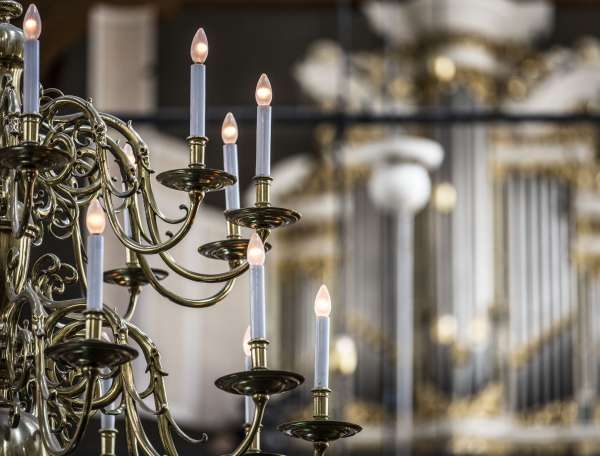

Sie werden aus Saba alle kommen
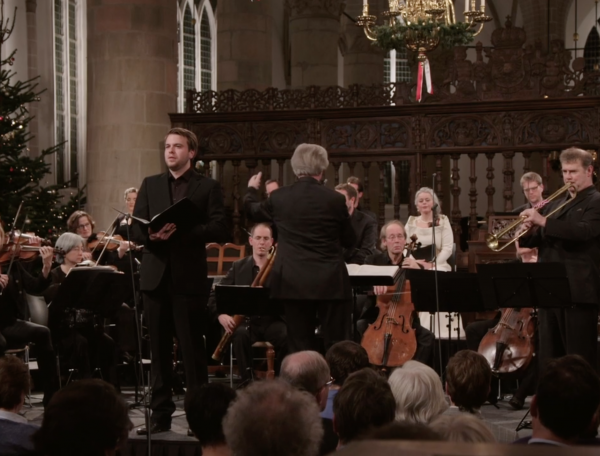
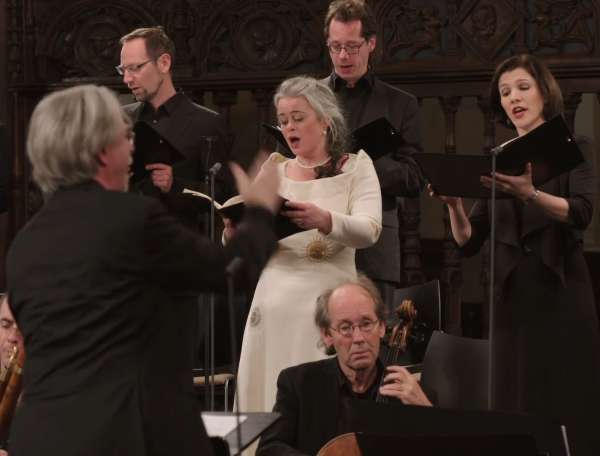
BWV 65 performed by the Netherlands Bach Society
conducted by Hans-Christoph Rademann
Grote Kerk, Harlingen
Behind the music
Story
Story
Extra videos
Extra videos
Texts
Texts
Credits
Credits
An Eastern touch
Bach appears to revel in exotic sounds
The three magi came from distant parts. They travelled from the East (Saba or Sheba was probably located somewhere in present-day Yemen) to Bethlehem in order to see the newborn Jesus. Bach illustrated their exotic origins with ‘oriental’ sounds. He opted for a varied instrumental setting, including strings, horns, recorders and oboes da caccia. “It’s very beautifully done”, says conductor Hans-Christoph Rademann. “The mix of sounds in the instrumental introduction is like a wonderful organ. Voice by voice, in canon, the different choir parts then enter in a rising line. Bach thus creates the image of the curious bystanders coming together to behold the exotic visitors”.
Bach rounded off his first Christmas cycle in Leipzig with this composition. He appears to revel in the exotic sounds, with the whole orchestra resounding in unison now and then in the opening procession. When the swaying bars in 12/8 time, representing the caravan, come to a halt, the music zooms in on the plain stable where Jesus lies. And the ball is once again in the court of the Lutherans. Although we have no exotic gifts like myrrh and gold to offer, we can give our souls to Jesus. In the aria sung by the bass, where this message is expressed, the two oboes da caccia seem to create more of a pastoral than an exotic atmosphere.
Extra videos
Vocal texts
Original
1. Chor
Sie werden aus Saba alle kommen,
Gold und Weihrauch bringen,
und des Herren Lob verkündigen.
2. Choral
Die Kön’ge aus Saba kamen dar,
Gold, Weihrauch,
Myrrhen brachten sie dar,
Halleluja!
3. Rezitativ (Bass)
Was dort Jesaias vorhergesehn,
das ist zu Bethlehem geschehn.
Hier stellen sich die Weisen
bei Jesu Krippe ein
und wollen ihn als ihren König preisen.
Gold, Weihrauch, Myrrhen sind
die köstlichen Geschenke,
womit sie dieses Jesuskind
zu Bethlehem im Stall beehren.
Mein Jesu, wenn ich jetzt
an meine Pflicht gedenke,
muss ich mich auch zu deiner Krippe kehren
und gleichfalls dankbar sein:
Denn dieser Tag ist mir ein Tag der Freuden,
da du, o Lebensfürst,
das Licht der Heiden
und ihr Erlöser wirst.
Was aber bring ich wohl, du Himmelskönig?
Ist dir mein Herze nicht zu wenig,
so nimm es gnädig an,
weil ich nichts Edlers bringen kann.
4. Arie (Bass)
Gold aus Ophir ist zu schlecht,
weg, nur weg mit eitlen Gaben,
die ihr aus der Erde brecht!
Jesus will das Herze haben.
Schenke dies, o Christenschar,
Jesu zu dem neuen Jahr!
5. Rezitativ (Tenor)
Verschmähe nicht, du, meiner Seele Licht,
mein Herz, das ich in Demut zu dir bringe;
es schliesst ja solche Dinge
in sich zugleich mit ein,
die deines Geistes
Früchte sein.
Des Glaubens Gold, der Weihrauch des Gebets,
die Myrrhen der Geduld sind meine Gaben,
die sollst du, Jesu, für und für
zum Eigentum und zum Geschenke haben.
Gib aber dich auch selber mir,
so machst du mich zum Reichsten auf der Erden;
denn, hab ich dich, so muss
des größten Reichtums Überfluss
mir dermaleinst im Himmel werden.
6. Arie (Tenor)
Nimm mich dir zu eigen hin,
nimm mein Herze zum Geschenke.
Alles, alles, was ich bin,
was ich rede, tu und denke,
soll, mein Heiland, nur allein
dir zum Dienst gewidmet sein.
7. Choral
Ei nun, mein Gott, so fall ich dir
getrost in deine Hände.
Nimm mich und mach es so mit mir
bis an mein letztes Ende,
wie du wohl weisst, dass meinem Geist
dadurch sein Nutz entstehe,
und deine Ehr je mehr und mehr
sich in ihr selbst erhöhe.
Translation
1. Chorus
They will all come from Sheba,
bring gold and frankincense,
and herald the Lord’s praise.
2. Chorale
The kings came from Sheba there [to Bethlehem];
[Gifts of] gold, frankincense,
and myrrh they brought there.
Hallelujah.
3. Recitative (Bass)
What Isaiah had foreseen there [in Jerusalem],
That has come to pass in Bethlehem.
Here the wise men appear
At Jesus’s manger
And wish to extol him as their king.
Gold, frankincense, and myrrh are
The lavish presents
By which they honor
This infant Jesus in the stable at Bethlehem.
My Jesus, when I now
reflect upon my duty,
I too must direct myself to your manger,
And be likewise [with the wise men] thankful,
For this day [of your epiphany] is to me a day of joy,
When you, O prince of life,
Become the light of the gentiles
and their redeemer.
But what might I well bring, you king of heaven?
If, to you, my heart is not too paltry,
Then accept it mercifully,
For I am able to bring nothing finer.
4. Aria (Bass)
Gold from Ophir is too plain [an offering];
Away, just away with empty gifts
That you mine from the earth;
Jesus wishes to have your heart.
Make a present of this [your heart], O Christian flock,
To Jesus at [Epiphany,] the [High] New Year.
5. Recitative (Tenor)
Do not spurn–You [Jesus], the light of my soul–
My heart, which in humility I bring to you;
It [my heart] includes within itself,
All together, indeed such things
[as these pleasing gifts]
That are the fruits of your spirit.
The gold of faith, the frankincense of prayer,
The myrrh of patience are my gifts
That you, Jesus, ever and ever
Shall have as possessions and as presents.
But do also give yourself to me;
Thus you will make me the richest person on earth,
For if I have you [here and now], then
The greatest abundance of riches
Must one day become mine in heaven.
6. Aria (Tenor)
Take me up as your own;
Take my heart as a present.
All, all that I am,
That I say, do, and think,
Shall, my savior,
Be dedicated in service only to you alone.
7. Chorale
Ah, now, my God, thus to you I fall,
Into your hands, comforted.
Take me and make it so with me
Up until my final end,
The way you well know, so that thereby
The benefit to my spirit [of its salvation] may arise,
And [so that] your honor, ever more and more,
May, indeed, lift itself up in me.
transl. © Daniel R. Melamed and Michael Marissen
For the annotated version of the text and translation, see here.
Last update: August 2026
Credits
-
- Release date
- 6 January 2017
-
- Recording date
- 23 January 2016
-
- Location
- Grote Kerk, Harlingen
-
- Conductor
- Hans-Christoph Rademann
-
- Tenor
- Daniel Johannsen
-
- Bass
- Matthew Brook
-
- Ripieno soprano
- Lauren Armishaw, Lucie Chartin, Zsuzsi Toth
-
- Ripieno alto
- Elsbeth Gerritsen, Bart Uvyn, Barnabas Hegyi
-
- Ripieno tenor
- Immo Schröder, Kevin Skelton
-
- Ripieno bass
- Sebastian Myrus, Drew Santini
-
- Violin 1
- Sayuri Yamagata, Anneke van Haaften, Annelies van der Vegt
-
- Violin 2
- Pieter Affourtit, Hanneke Wierenga, Lidewij van der Voort
-
- Viola
- Staas Swierstra, Jan Willem Vis
-
- Cello
- Lucia Swarts, Richte van der Meer
-
- Double bass
- Robert Franenberg
-
- Oboe da caccia
- Martin Stadler, Peter Frankenberg
-
- Recorder
- Benny Aghassi, Lara Morris
-
- Horn
- Erwin Wieringa, Gijs Laceulle
-
- Bassoon
- Benny Aghassi
-
- Organ
- Bart Naessens
-
- Harpsichord
- Siebe Henstra
-
- Director
- Simon Aarden
-
- Assistant director
- Ferenc Soetman
-
- Music recording
- Guido Tichelman, Bastiaan Kuijt, Micha de Kanter
-
- Music edit and mix
- Guido Tichelman
-
- Camera
- Bart ten Harkel, Thijs Struick, Chris Reichgelt
-
- Lights
- Daan de Boer, Arjen Seykens
-
- Video engineer
- Vincent Nugteren
-
- Set technique
- Martin Struijf, Glenn van den Eerden, Marco Korzelius
-
- Data handling
- Jasper Blok
-
- Project manager nep
- Peter Ribbens
-
- Interview
- Gijs Besseling, Jan Van den Bossche
-
- Producer concert
- Imke Deters
-
- Producer film
- Marco Meijdam
Help us to complete All of Bach
There are still many recordings to be made before the whole of Bach’s oeuvre is online. And we can’t complete the task without the financial support of our patrons. Please help us to complete the musical heritage of Bach, by supporting us with a donation!